
The Learning Differences Evidence Hub comprises promising approaches, practitioner challenges, and practical strategies to help strengthen inclusive practices and support every learner. An estimated 1 in 10 children globally have a disability, yet many education systems—particularly in low- and middle-income countries fail to meet their needs.

Strategic Priority

Knowledge Accelerator

Funding Catalyst

Partnership Builder

Strengthening support for children with learning differences in low-resource education settings

An estimated 1 in 10 children globally have a disability, according to UNICEF, yet many education systems in low and middle income countries (LMICs) fail to meet their needs. The Evidence Hub consolidates practical strategies, tools and case studies to strengthen inclusive practice and support every learner.

GSF's approach to Learning Differences in LMICs

In 2025, GSF conducted a scoping study to establish how children with learning differences are supported in LMICs. Through literature reviews, expert interviews and practitioner consultations, the study mapped what exists, what is missing, and where support is most needed. 

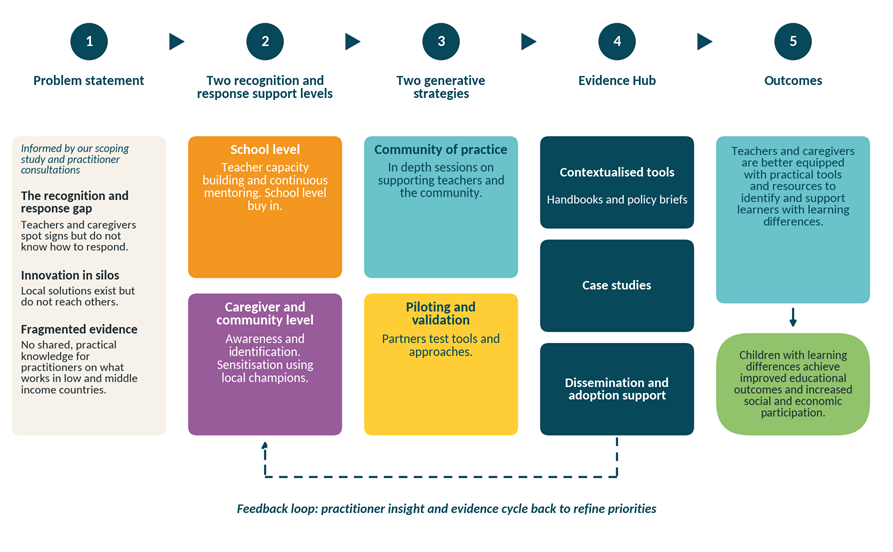
A five-part community of practice convened frontline practitioners around screening and diagnostics, teacher training, curriculum and assessment, pedagogy and community engagement, and four blogs disseminated emerging insights. Three persistent gaps were identified: teachers and caregivers recognise signs of struggle but lack the means to respond, effective local innovations remain isolated, and evidence on what works is fragmented. 

How the Evidence Hub responds to the gaps the research identified

To address these gaps, GSF established the Evidence Hub, which operates at two levels. At school level, it strengthens teacher capacity through continuous mentoring and secures the commitment of school leaders. At caregiver and community level, it promotes awareness and identification in partnership with local champions. Two strategies generate the evidence the hub disseminates: peer learning through a community of practice, and the piloting and validation of promising approaches.

How the Evidence Hub is structured: a framework centred on the child

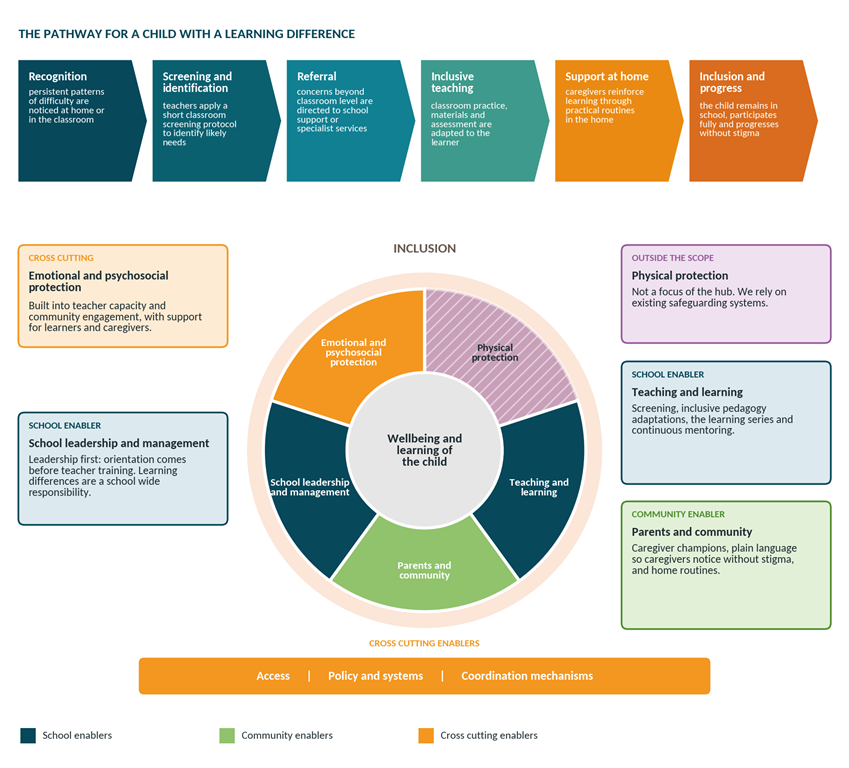
GSF is structuring its work around the Learning Differences Framework, which follows a child from recognition to continuous support. The framework was created by drawing on Bronfenbrenner’s Ecological Systems Theory and the Save the Children Quality Learning Framework, and specifies the school and community enablers required at each stage. Every resource in the hub is tagged to one of its four areas.

Image

Strategy 1: Building teacher capacity through peer learning and the practitioner learning series

Peer learning through a community of practice constitutes the first strategy for generating evidence. Its principal component is the practitioner learning series, established in response to requests from practitioners for rigorous, practical technical support. The first series is directed at those able to cascade inclusive practice to teachers within their own organisations: master trainers, programme leads, heads of school networks and focal persons for teacher development. Six sessions, running from August 2026 to January 2027, produce a teacher training handbook for organisations to train their own teachers. A second series for caregivers and communities will follow.

Image

Strategy 2: Testing promising approaches through pilots with GSF community organisations

Piloting and validation constitutes the second strategy for generating evidence. Small catalytic grants will enable organisations within the GSF community to test promising approaches.

Practical resources for supporting children with learning differences

Recordings, blogs, tools and handbooks developed with and for practitioners in low- and middle-income countries. Each resource is tagged to one of four areas of the Learning Differences Framework: school leadership and management, teaching and learning, parents and community, and emotional and psychosocial protection. Resources may also be located by stage of the child's journey.

Blogs
x

Seeing the Invisible: Understanding Learning Differences in LMICs

Presents scoping study findings on the learning differences most frequently identified in LMICs.

View blog
x

Spotting the signs: Communities leading early identification

Examines how organisations in Ghana, Nigeria and Uganda approach early identification.

View here
x

Transforming learning spaces: Teacher development and inclusive classroom strategies

Examines teacher development and inclusive classroom strategies in LMIC classrooms.

View here
x

Beyond Access: Advancing inclusive learning through community and system change

Examines how addressing stigma enables caregivers to advocate for children with learning differences.

View here