

All in for all children
To the 150+ innovators, educators, entrepreneurs, and funders from 80+ organisations and over 50 countries that made this year’s Annual Meeting so electric—from Colombia to Nepal, India to Ghana, Kenya, Tanzania, Liberia, Nigeria, Uganda, and Pakistan, whether you attended in person or were with us in spirit—we say: thank you for joining us!
All in for all children: this was more than just the theme of our Annual Meeting — it was a rallying cry, a shared commitment to show up for every child, everywhere. In a time of shifting global priorities and uncertain funding landscapes, our collective resolve to ensure quality education for all children matters more than ever. As we gathered in Nairobi, this message resonated through every conversation, every session, and every connection made.
You are not just education innovators in the non-state education sector—you are critical pieces of infrastructure in the system, and your dedication to reaching every child with quality education continues to inspire us.

A community alive with energy and purpose
The energy in Nairobi was nothing short of electric. Our Annual Meeting brought together a vibrant global community that sparked with possibility at every turn. This wasn’t simply another conference—it was a convergence of the most innovative minds in non-state education, a rare gathering where practitioners working in vastly different contexts could learn from shared challenges and celebrate collective progress.
As a community convenor, Global Schools Forum creates these unique spaces where education innovators from across continents can learn, connect, and grow together. The power of bringing this community together cannot be overstated: when a school leader from Sierra Leone sits alongside an entrepreneur from India, when a funder from the United States engages directly with practitioners from Uganda, when government partners from Kenya collaborate with innovators from Pakistan—magic happens. Solutions are born. Partnerships are forged. And the ripple effects across the education landscape will be felt for years to come.
Over four intensive days, we covered vast terrain. Our programme wove together in-depth working sessions, dynamic plenaries, hands-on workshops, intimate conversations, and collaborative breakouts that tackled some of the most pressing challenges in education today: Secondary Education, Socio-Emotional Learning, the Climate Emergency, Learning Differences, and Monitoring, Evaluation and Learning. We didn’t just discuss these topics—we rolled up our sleeves and worked on them together, sharing evidence, co-creating solutions, and building the knowledge base that will drive our collective impact forward.
Our Founder and CEO, Aashti Zaidi Hai, also set the scene and shared GSF’s bold ambition for the next three years. The new strategy focuses GSF as a knowledge accelerator, funding catalyst, partnership builder, and community convenor supporting non-state education organisations to innovate, deepen impact, and achieve scale.
From early morning sessions to late-night conversations, there was a palpable sense of momentum—a collective understanding that we’re stronger together, that our shared challenges require shared solutions, and that the innovations happening in classrooms from Nairobi to New Delhi hold the keys to transforming education for millions of children

Learning from the ground
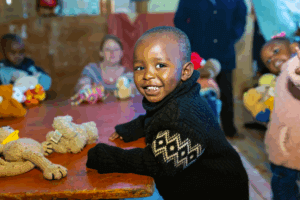
One of the most powerful aspects of our Annual Meeting is the opportunity to step out of conference rooms and into classrooms. This year, attendees visited partners including Kidogo, Rare Gem Talent School, SHOFCO, and Tiny Totos. These visits weren’t just about observation—they were about understanding shared challenges, celebrating local innovations, and seeing firsthand the incredible work happening in our community.
There’s something transformative about watching children learn, about speaking with teachers navigating resource constraints with creativity and determination, and about witnessing the impact of the solutions our community is building. These visits grounded our conversations in reality and reminded us why this work matters.
Building coalitions for sustainable change
Our afternoon session on the Coalition for the Childcare Economy showcased the kind of multi-stakeholder collaboration that will define our success in reaching 250 million children. Carren Ageng’o, Permanent Secretary for Childcare Services in the Government of Kenya, articulated both the challenge and the opportunity beautifully:
“This coalition presents an extraordinary opportunity for shared learning and for the Government of Kenya. We welcome GSF to partner with us to create a coalition roadmap to connect the practitioners with evidence for policy and advocacy in the childcare economy.”
Her words captured a critical truth: governments cannot do this alone, and neither can innovators. Ageng’o reminded us that “childcare is not charity. It is an investment and smart economics; the benefits outweigh the cost.” This kind of partnership—where government commitment meets practitioner expertise and evidence—is exactly what will drive sustainable change.

Navigating a challenging funding landscape together
The reality of shrinking foreign aid to education hung over many of our conversations, but rather than despair, we saw determination. Martin Kungania from Kenya’s Ministry of Education put it plainly: “All of us are aware that funding has changed. Education is a service like health and governments across the globe can’t provide these services without support of partners.”
Dr. Ruth Kagia from GPE emphasised the need for long-term commitment and strategic alignment: “You need to be there for the long haul. Building coalitions, gathering and showing evidence—it’s a minimum of a decade to build the credibility and case for your innovation.”
Her message was clear: in this changing landscape, we must focus on cost-effectiveness, evidence generation, and alignment with government priorities. We must support governments to better allocate their resources and demonstrate the impact of foundational learning and numeracy solutions that work.
Innovations taking centre stage
Throughout the week, organisations from our Impact at Scale Labs and the wider GSF community took centre stage to showcase their solutions. Organisations like Dignitas, Involve, Duara Education, Kenya Connect, Peepul, Sabre Education, and Room to Read presented their innovations to a room full of potential collaborators, partners, and funders—exactly the kind of connections that can accelerate impact.
This showcase represents a critical element of what Global Schools Forum does as a funding catalyst and community convener. By creating platforms for our members to present their work, we’re actively enabling organisations in our community to access funding opportunities and connect with our global network of funders, technical experts, and fellow innovators. These aren’t simply presentations—they’re doorways to new partnerships, scaled implementations, and the kind of collaborative problem-solving that the education sector desperately needs.
The showcase sessions sparked conversations that continued long after the formal presentations ended, with attendees engaging in one-to-one discussions to explore how proven models might be adapted to different contexts. For many organisations, these connections represent potential pathways to reaching thousands—or even millions—more children.
A launchpad for what's next
As we close this chapter and look ahead, we’re filled with renewed energy and inspiration. Our Annual Meeting in Nairobi wasn’t just a gathering—it was a launchpad. It reminded us that together, with our community of partners, funders, innovators, and practitioners, we can solve the learning crisis together.
We’re looking forward to embarking on this new strategy period with all of you, working hand in hand to improve education outcomes for all children in the global south. The spark we felt in Nairobi will fuel our work in the months and years ahead.

Because we’re all in. For all children.
Share this article



 AI and Education